
- Luxury travel in 2025 is defined by familiarity, ease, and emotional connection
- Repeat destinations are replacing novelty as the ultimate luxury
- Travelers are seeking belonging, not just escape
- The line between travel and lifestyle is increasingly blurred
- Modern luxury is designed around how people actually live
Luxury travel used to be about leaving life behind.
A break from routine.
A temporary escape.
A short-lived indulgence before returning home.
But in 2025, something has shifted.
For a growing number of affluent travelers, travel no longer feels like a departure. It feels like an extension of life — familiar, comfortable, and deeply personal.
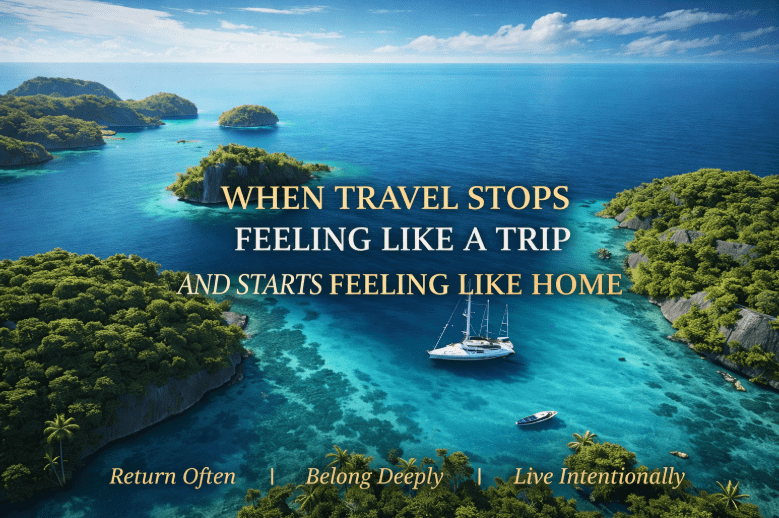
At a certain point, travel stops feeling like a trip.
It starts feeling like home.
The Emotional Shift Behind Modern Luxury Travel
The most significant changes in luxury travel today aren’t driven by destinations, hotels, or amenities.
They’re driven by how people want to feel.
Luxury travelers are no longer seeking constant stimulation. Instead, they’re prioritizing:
- Calm over excitement
- Comfort over novelty
- Ease over excess
- Presence over performance
This emotional recalibration has redefined what luxury means.
Five-star experiences are no longer measured by how impressive they look, but by how effortlessly they fit into a traveler’s life.
Why Familiarity Has Become a Luxury
One of the clearest signs of this shift is the rise of repeat destinations.
More travelers are choosing to return to the same places year after year — the same coastline, the same mountain town, the same neighborhood — not because they lack curiosity, but because familiarity itself has become a form of luxury.
Familiar destinations offer:
- Predictable comfort
- Reduced decision fatigue
- Faster relaxation upon arrival
- A sense of rhythm and continuity
There is luxury in knowing exactly where to go, what to expect, and how to settle in immediately.
Travel becomes smoother.
Time stretches.
The experience deepens.
When You Stop Feeling Like a Visitor
Something subtle happens when travelers return to a place often enough.
They stop behaving like tourists.
They know which routes to take.
They have favorite cafés.
They recognize familiar faces.
The destination stops being something to “consume” and starts becoming something to belong to.
This is the moment when travel begins to feel less transactional and more relational.
Less about what you can do —
and more about how you live while you’re there.
The Redefinition of Escape
Traditionally, escape meant getting away from daily life.
In 2025, escape looks different.
Escape now means stepping into a version of life that feels calmer, more spacious, and more intentional — without completely disconnecting from who you are.
Luxury travelers want environments that allow them to:
- Maintain routines they enjoy
- Spend unhurried time with family
- Work selectively or creatively, if desired
- Feel grounded rather than displaced
Travel is no longer a pause button.
It’s a parallel track.
How Travel Becomes Part of a Lifestyle
As trips grow longer and destinations more familiar, many travelers begin to organize their year around places rather than dates.
A few weeks each summer in the same coastal town.
A winter escape to the same mountain retreat.
A seasonal rhythm that repeats.
This shift transforms travel from an event into a lifestyle layer.
Instead of planning from scratch each time, travelers build a framework — one that supports rest, reconnection, and continuity.
Luxury, in this context, is not spontaneity.
It’s stability with flexibility.
Why This Shift Feels So Satisfying
There’s a psychological comfort in returning to places that feel known.
Familiar environments reduce cognitive load. They create emotional safety. They allow people to relax faster and more fully.
This is especially true for families, couples, and professionals whose lives are already full of decisions.
Luxury becomes less about stimulation —
and more about ease of being.
When a place feels like home, even temporarily, it allows travelers to experience presence instead of pressure.
The Blurring Line Between Travel and Belonging
As travel becomes more integrated into daily life, the boundary between “going away” and “being there” starts to dissolve.
Travelers begin to think less in terms of trips and more in terms of places.
Places they return to.
Places they feel connected to.
Places that hold memories across years.
This is where the concept of travel as lifestyle fully emerges.
It’s not about owning a destination —
it’s about belonging to one.
What This Means for the Future of Luxury
The future of luxury travel is not about more movement.
It’s about meaningful repetition.
Fewer destinations.
Deeper connections.
Longer stays.
Greater alignment with how people actually want to live.
Luxury is no longer episodic.
It’s designed.
Final Thought
When travel stops feeling like a trip and starts feeling like home, it signals something profound.
It means luxury has shifted from novelty to nourishment.
From escape to alignment.
From occasional indulgence to intentional living.
And for modern travelers, that may be the greatest luxury of all.