

For a long time, sustainability and luxury occupied separate conversations. One was about constraint, about reducing, offsetting, and accounting for impact. The other was about abundance, about exceptional experiences pursued without apology. The idea that they might belong together, that the most refined way to travel could also be the most responsible, seemed, to many, like wishful thinking.
In 2026, that tension has largely resolved. Not because the challenges of sustainable travel have disappeared, but because the most discerning travelers have come to understand something that reframes the entire question: genuine luxury and genuine stewardship are not in conflict. They are, at their deepest level, expressions of the same value. Care for the places, people, and ecosystems that make exceptional experiences possible is not a constraint on indulgence. It is its most sophisticated expression.
A Shift That Is Now Structural
The movement toward sustainable luxury travel has passed the point of being a trend. It is now a structural feature of how the upper end of the market operates, reflected in property design, itinerary construction, operator partnerships, and the purchasing decisions of buyers whose environmental values have become as non-negotiable as their quality standards.
Industry data supports what any attentive observer of the market can already see. A significant majority of luxury consumers now factor environmental credentials into accommodation and experience choices, and the proportion continues to grow. Green certifications, independently verified and rigorously maintained, have become a meaningful differentiator among properties competing for the attention of the most informed buyers. The question is no longer whether sustainability matters in luxury travel. It is how to distinguish genuine commitment from well-positioned marketing.
What Responsible Luxury Looks Like in Practice
The most compelling examples of sustainable luxury travel share a common quality: they do not ask guests to accept less in exchange for environmental responsibility. They demonstrate, through design and operation, that the two can coexist at the highest level.
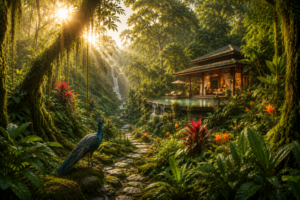
Costa Rica’s eco-lodge sector has set a standard that the rest of the world is still catching up to. Properties here offer amenities that compete with the finest conventional resorts: infinity pools, gourmet dining, spa facilities, and impeccably designed accommodations. What distinguishes them is the integration of these elements within an operating model built around biodiversity preservation, on-site organic agriculture, and genuine support for the surrounding communities. The experience is richer for the context, not despite it.
Similar principles are being applied across a widening range of destinations. Botswana’s conservation-led safari lodges offer wildlife experiences of extraordinary depth, structured to protect the ecosystems they depend upon. Coral restoration programs in the Maldives give travelers direct and meaningful participation in the preservation of the reefs that define the destination’s beauty. These are not add-on activities. They are experiences that transform a journey from a beautiful escape into something with genuine lasting significance.
Mobility and the Transportation Question
The sustainability conversation in luxury travel cannot avoid the transportation question, and the most honest engagement with it acknowledges both the progress being made and the distance still to travel.
Shared mobility innovations are expanding the options available to environmentally conscious travelers. Electric yachts offer a quieter, cleaner way to access coastal and island destinations. Private eVTOL aircraft are beginning to demonstrate the practical possibility of short-range travel without the carbon footprint of conventional aviation. Bookings for these alternatives have grown substantially in recent years, driven by genuine demand from travelers who want their transportation choices to reflect the same values as their accommodation choices.
The limitations are real. The infrastructure for truly low-emission long-haul travel remains in development, and the most remote destinations, which are often among the most ecologically significant and most appealing to luxury travelers, are frequently the hardest to reach without meaningful environmental impact. Carbon offset programs, when they are genuine and independently verified, provide a partial answer. The more complete answer lies in traveling less frequently but for longer, a principle that aligns naturally with the intentional, depth-over-breadth approach that defines the most considered luxury travel in 2026.
Navigating Greenwashing With Confidence
The growth of sustainable luxury travel has been accompanied, inevitably, by the growth of sustainability claims that do not withstand scrutiny. Greenwashing, presenting environmental credentials that are superficial, unverified, or actively misleading, is a real and persistent feature of the market, and it warrants careful attention from any buyer who takes these values seriously.
The most reliable protection is third-party certification from organizations with rigorous and transparent standards. The Global Sustainable Tourism Council provides one of the most respected frameworks in the industry, and properties that have earned and maintained its accreditation have demonstrated a genuine commitment to environmental and social responsibility that goes well beyond aesthetic choices. Water recycling systems, zero-waste operational policies, supply chain accountability, and community benefit programs are among the features that distinguish certified properties from those whose sustainability positioning rests primarily on visual cues.
Asking direct questions and expecting specific answers is equally important. A property genuinely committed to sustainable operation will have data to share: energy consumption figures, waste diversion rates, sourcing policies, and community partnership details. One whose commitment is primarily cosmetic will tend toward generality. The difference is usually apparent quickly, and it is worth the effort to find it.
Regulation, Compliance, and the Forward View
The external environment for sustainable luxury travel is also shifting in ways that will accelerate the sector’s evolution regardless of individual buyer preferences. Regulatory frameworks targeting the environmental impact of international travel and real estate are tightening across major markets. The European Union’s carbon border adjustments are among the most significant of these developments, and their influence on how international travel is priced and structured will be felt across the industry in the years ahead.
For travelers and property owners who have already integrated sustainability into their decision-making, this regulatory direction represents confirmation rather than disruption. For those who have not, it represents an increasingly compelling reason to begin. The operators who have built genuine environmental accountability into their business models are positioned well for a future in which these standards become mandatory rather than aspirational.
Indulgence as a Force for Good
The deepest reframing that sustainable luxury travel offers is a new definition of what indulgence actually means. If the finest experiences are those that are most deeply connected to the places, people, and ecosystems that make them possible, then caring for those places, people, and ecosystems is not a constraint on indulgence. It is its fullest expression.
A guided wildlife experience in a landscape actively protected by the lodge that hosts you is more extraordinary than the same experience in a landscape being slowly depleted. A meal prepared from ingredients grown on the property where you are staying, by people whose livelihoods are genuinely supported by your presence, is richer than one assembled from an anonymous supply chain. These are not compromises. They are enhancements, available only to those who have chosen to travel with intention.
True luxury in 2026 is not measured by the scale of consumption it enables. It is measured by the quality of what it preserves, and by the legacy of care it leaves behind in every place it touches.