
Key Takeaways
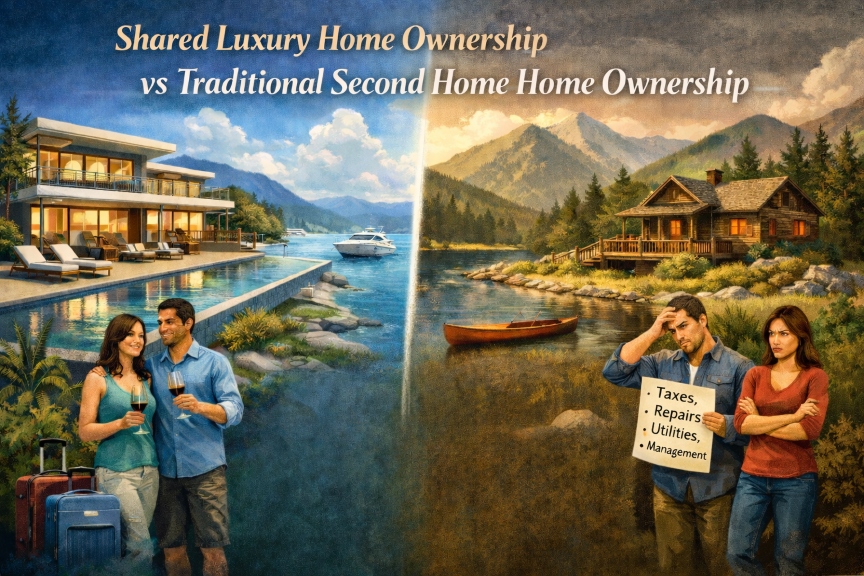
- Traditional second home ownership offers full control, but it often comes with higher costs, more maintenance, and more lifestyle friction than people expect.
- Shared luxury home ownership can deliver a true home base with less burden, making it a strong fit for the hybrid lifestyle.
- The best choice depends on how you actually travel, how often you want to be there, and how much responsibility you want to carry.
Owning a second home can sound like the ultimate luxury.
A familiar destination. A beautiful space. A place that feels like yours.
But many affluent travelers eventually discover a quiet truth. Traditional second home ownership is not only about enjoying the home. It is also about managing it. Maintaining it. Funding it. Worrying about it, even when you are not there.
That is why shared luxury home ownership has become a serious alternative for modern lifestyle driven buyers.
It offers a different version of luxury. One that emphasizes access, ease, and a smarter rhythm. It supports the hybrid lifestyle, where you blend belonging with exploration instead of tying all of your travel life to one heavy commitment.
If you are deciding between shared ownership and traditional ownership, this comparison will help you clarify what actually fits your life.
What traditional second home ownership looks like
Traditional second home ownership means you purchase a vacation property on your own. You own the home outright, you control every detail, and you take on every responsibility.
For some buyers, that control is the entire point. You choose the furnishings, you decide the upgrades, you set the rules, and you can use the home whenever you want.
But it comes with realities that are easy to underestimate.
Even a high end second home requires ongoing attention. Maintenance, landscaping, repairs, staffing, security, utilities, insurance, taxes, and constant decision making. If the home is in a destination market, there may be climate considerations, seasonal wear, and vendor coordination.
The home can be a dream, but the management can feel like a second job.
What shared luxury home ownership looks like
Shared luxury home ownership means you own a portion of a high end property alongside a small group of other owners.
In many models, the home is professionally managed. Time is allocated through a scheduling system. The property is maintained to a consistent standard. The experience is designed to be more seamless.
The difference is not just financial. It is lifestyle.
Shared ownership often appeals to affluent travelers who want a true home base, but do not want the full burden of traditional ownership. They want to arrive, enjoy, and leave without carrying the constant obligations that follow sole ownership.
For hybrid lifestyle travelers, this is key. It creates belonging without eliminating the freedom to explore elsewhere.
Comparison: the factors that matter most
1. Cost and capital efficiency
Traditional ownership typically requires a large amount of capital tied up in one property. Beyond the purchase price, there are closing costs, ongoing taxes, insurance, utilities, and maintenance, whether you use the home or not.
Shared ownership spreads that cost across owners. You still invest in a premium home, but you are not funding 100 percent of the asset and its carrying costs.
For affluent buyers, this is often less about affordability and more about efficiency. Many prefer having a lifestyle home base while keeping capital available for other investments and experiences.
2. Maintenance and lifestyle friction
This is where many second home dreams collide with reality.
Traditional ownership means you coordinate everything, directly or through vendors. Even with a property manager, decisions still come to you. Repairs, replacements, upgrades, storms, leaks, landscaping, pests, turnover, staffing, and seasonal issues can become a constant stream of tasks.
Shared luxury ownership often reduces this friction through professional management. The home is maintained to a consistent standard, and the operational burden is lighter for the owner.
Smart luxury often means fewer decisions, fewer surprises, and less mental load.
3. Flexibility and how you actually travel
Traditional ownership can be ideal if you want unlimited, spontaneous use, or if you spend long stretches in one destination.
But many affluent travelers do not travel that way. They travel in seasons. They travel in shorter blocks. They travel with variety.
Shared ownership aligns well with that pattern because it is structured around meaningful, predictable usage. You plan your stays, return regularly, and still have space in your calendar to explore.
This is the hybrid lifestyle in action. You have a home base, but you are not locked into it.
4. Quality of home and location
Traditional ownership gives you the freedom to choose any home you want, but quality depends on your ability and willingness to manage it.
Shared luxury ownership often concentrates resources into a single high quality property. Because costs are shared, the home may be more premium than what a buyer would choose alone in the same market.
This can mean better design, better amenities, better location, and a consistent luxury standard.
5. Emotional experience: belonging, identity, tradition
Traditional ownership can create deep belonging. It becomes your place in the world. It can become part of your identity.
Shared ownership can also create that feeling, especially if you return regularly, celebrate traditions there, and build rituals around your time in the home.
The difference is that shared ownership tends to protect the experience from becoming a burden. For many, that protection is what makes belonging sustainable long term.
6. Travel freedom and the hybrid lifestyle
Traditional ownership can sometimes narrow travel behavior. When you own a home alone, you may feel pressure to use it often to justify the costs. That can unintentionally limit exploration, even if you love traveling to new places.
Shared ownership can support a more balanced rhythm. You belong somewhere, but you still keep room for discovery trips, including under the radar destinations that feel quieter and more intentional.
If your ideal life includes both returning and exploring, shared ownership often matches that vision more naturally.
Which option is best for you?
Traditional second home ownership may be a better fit if:
You want full control over the home and its use.
You spend extended periods in one destination.
You enjoy managing property decisions or have a trusted team.
You want complete flexibility without scheduling.
Shared luxury home ownership may be a better fit if:
You want a home base without full operational responsibility.
You prefer predictable usage and a managed experience.
You value capital efficiency and lifestyle simplicity.
You want to maintain freedom for under the radar travel and exploration.
You resonate with the hybrid lifestyle, belonging plus discovery.
A simple way to decide
Ask yourself three questions:
How often will I realistically use this home each year?
Do I want ownership, or do I want the experience of arriving to a ready home?
Do I want my travel life to revolve around one destination, or support both belonging and exploration?
Your answers will usually make the right choice obvious.
Final thoughts
Both traditional second home ownership and shared luxury home ownership can offer an elevated lifestyle.
The difference is the weight you carry to get it.
Traditional ownership can offer full control, but it can also bring high costs, high responsibility, and ongoing mental load. Shared ownership can offer a premium home base with less friction, more efficiency, and a travel rhythm that supports the hybrid lifestyle.
Modern luxury is increasingly about ease. About intention. About living well without unnecessary burden.
If that is your direction, shared luxury home ownership is worth a serious look.