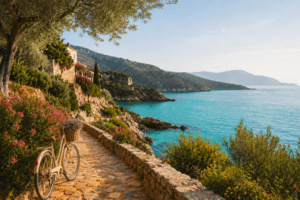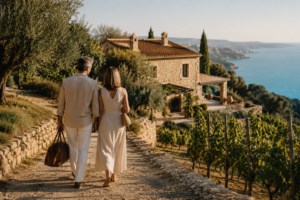


In this article, we step inside the lived experience of the hybrid lifestyle to examine not its structure or its logic, but its texture: the specific sensory, quietly extraordinary pleasures that people who have built it well consistently describe, and that no amount of research about platforms and governance frameworks can quite prepare you for.
There is a body of knowledge about the hybrid lifestyle that this series has worked to build carefully across many articles: the destination evaluation criteria, the platform selection process, the way the model evolves across different life stages. This knowledge matters, and having it changes the quality of the decisions that follow.
But there is another kind of knowledge that is available only from the inside, and that no analytical framework can fully transmit. It is the felt knowledge of what the hybrid life actually is to live: the texture of its ordinary moments, the particular quality of its pleasures, and the specific things that people who have built it well describe when asked not what it looks like but what it feels like.
This article is an attempt to convey some of that interior knowledge, for the reader who has absorbed the logic and wants now to inhabit the experience, at least in imagination, before committing to the life.
The Particular Pleasure of the Known Arrival
There is a specific quality to arriving somewhere that already knows you, and it is different in kind from even the finest hotel welcome, however warm and professional that welcome might be.
It begins before the door opens. The knowledge that the view from the bedroom window will be exactly as you remember it, that the kitchen will be stocked in the particular way you prefer, that the bed will be made with the linens you have chosen across previous visits. These are small things, and their smallness is precisely the point. They are the accumulated residue of a relationship with a place, and they produce an ease of arrival that cannot be manufactured for a first-time guest; however, lavish the preparation.
The moment of crossing the threshold into a co-owned residence after an absence is consistently described by long-term owners as one of the most quietly satisfying moments in their travel year. Not dramatic, not extraordinary in any way that would make sense to describe to someone who had not experienced it, but deeply pleasant in the way that only genuine familiarity can produce. The particular pleasure of being somewhere that has been waiting for you, specifically, and that is ready not to a standard but to your standard.
This quality deepens with time. The tenth arrival at a beloved property carries something the first could not: the layered associations of every previous visit, the sense of a place that has accompanied you through different seasons of your own life, and the particular warmth of a return that is rich with its own history.
The Freedom That Structure Provides
One of the counterintuitive pleasures of the hybrid lifestyle is the degree to which its structured dimension, the scheduled returns, the allocated periods, the advance planning that anchors the year, produces a quality of freedom that unstructured travel rarely delivers.
The freedom in question is not freedom from constraint. It is freedom from the particular kind of low-grade anxiety that comes from having too many open questions simultaneously. When the anchor of the year is secured, when you know that a specific period in a specific beloved place is guaranteed and prepared for, the rest of the year opens in a way that feels genuinely expansive rather than simply unscheduled.
This is a pleasure that is easy to miss until you have experienced it from both sides. Travelers who have lived through periods of both purely open and hybrid-structured travel tend to describe the structured period as the one in which they felt paradoxically more free, because the baseline of certainty it provided gave the open periods their full quality of genuine possibility rather than vague availability.
The advance knowledge that something genuinely good is coming also produces the anticipatory pleasure that the series has touched on in previous articles: a sustained background of something to look forward to that enriches the ordinary weeks between departures in ways that are both real and underappreciated.
The Deepening That Only Repetition Produces
There is a form of knowledge about a place that is available only to those who have returned to it many times, and the pleasure it produces is qualitatively different from anything that a first or second visit can offer.
It is the pleasure of fluency. Of moving through a destination without the cognitive overhead of navigation, of knowing which road to take not because you have looked it up but because your body remembers it, of being recognized by the people who work in the places you return to and of recognizing them in return. Of knowing the restaurant whose best table is the one by the window on the left, and of being given it without asking.
This fluency extends into the landscape itself. A coastline or a mountain range known across multiple seasons reveals dimensions of itself that a single visit cannot access: the way the light changes between October and April, the particular quality of the place on a rainy morning versus a clear one, the seasonal rhythms of local life that are invisible to visitors but entirely legible to those who have returned often enough to have learned them.
The pleasure of this kind of deep familiarity is difficult to communicate to someone who has not experienced it, because it sounds like the opposite of the excitement that travel is supposed to provide. It is not the opposite. It is a different and, for many experienced travelers, a more satisfying register of the same fundamental pleasure: the pleasure of a world that continues to offer more of itself the more carefully you attend to it.
The Conversations That Only Happen in Familiar Places
Something changes in the quality of conversation that happens in a place where everyone present is genuinely relaxed. Not the polite relaxation of a fine hotel, in which the surroundings are excellent and the service is attentive, but the deeper ease of a place that is genuinely known, where the logistics have dissolved and what remains is simply the company and the setting.
People who have spent significant time in co-owned residences with family or close friends consistently describe the quality of conversation that happens there as distinct from what occurs in other contexts. The unhurried pace, the absence of the decision-making overhead that new destinations require, and the particular ease of a familiar space create the conditions for the kind of talk that matters most: the conversations that go somewhere, that cover territory that ordinary life does not make room for, that leave the people who have had them feeling more genuinely known.
This is not incidental to the co-ownership experience. It is, for many of the most satisfied long-term owners, among its most significant contributions to the quality of their lives and their closest relationships. The place enables the conversation, and the conversation justifies the place.
The Pleasure of Knowing What You Are Returning To
The exploratory half of the hybrid lifestyle has its own distinct texture, and it is worth describing separately because it is experienced differently when it exists alongside a known anchor rather than in the open field of total optionality.
The new destination visited by a hybrid traveler who has a beloved place to return to is experienced with a particular quality of openness. The pressure to find the new destination sufficient, to have it justify the decision to go there rather than somewhere familiar, is absent. The explorer can afford to be genuinely curious, genuinely open to disappointment as well as delight, and genuinely present in the experience of discovery rather than invested in its outcome.
This quality of pressure-free exploration tends to produce both better experiences and better decisions. Without the need to defend the choice of a new destination against the alternative of the familiar anchor, the explorer encounters it more honestly, is more likely to recognize it clearly for what it is, and is better positioned to know whether it deserves the more serious attention that eventual ownership would require.
The knowledge that there is something genuinely good to return to transforms the act of exploration from a search for the sufficient into a genuinely open inquiry, and the pleasure this produces, the freedom to discover without needing to find, is one of the hybrid lifestyle’s most characteristically satisfying qualities.
What It Feels Like, Finally
The hybrid lifestyle, lived well and over time, does not feel like a clever financial arrangement or a well-optimized travel strategy. It feels like a life that has been designed to fit the person living it, in which the places visited and the places owned have been chosen with genuine care and inhabited with genuine attention, and in which the rhythm of departure and return has become as natural and as sustaining as any other rhythm that defines a well-ordered life.
It feels like knowing where you are going and being glad about it. Like arriving somewhere and feeling immediately at home. Like leaving somewhere new with the quiet certainty that you will return. Like a year that contains within it, across all its ordinary weeks and demanding months, several periods of genuine restoration in places that have earned your loyalty and that continue, every time, to give back more than you bring.
This is not a dramatic feeling. It does not announce itself. It accumulates quietly across years, in the particular pleasure of a known arrival, the ease of a familiar landscape, the conversation that only a certain kind of unhurried place makes possible, and the simple, deeply satisfying knowledge that you have built something in your life that will continue to reward you for as long as you choose to return to it.
That, finally, is what the hybrid lifestyle feels like. And it is worth every considered decision that went into building it.