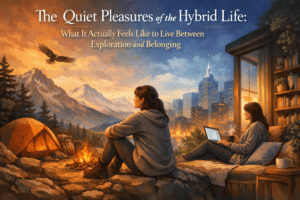


The categories that once defined how people related to place have quietly broken down. You were either a traveler or a homeowner, a nomad or a settler, someone who moved through the world or someone who had chosen their corner of it. These were presented as mutually exclusive orientations, each with its own logic and its own set of sacrifices. Choosing one meant accepting the limitations of the other.
What is becoming clear in 2026 is that a growing number of the world’s most thoughtful people have stopped accepting that choice. They are building lives that honor both impulses simultaneously, lives structured around genuine freedom of movement and genuine depth of connection, without treating either as a compromise of the other. The hybrid lifestyle is not a middle ground between two options. It is a third architecture entirely, and it is reshaping how luxury property, travel, and the very concept of home are understood.
A Response to How Life Actually Works
The hybrid lifestyle has gained momentum not as a philosophical statement but as a practical response to the genuine complexity of modern life. Remote work has decoupled professional productivity from physical location for a significant and growing segment of affluent professionals. Family structures have become more geographically distributed, with meaningful relationships spanning continents. And the accumulated experience of constant movement, for those who have pursued it fully, has gradually revealed its own form of depletion.
Industry surveys reflect this evolution clearly. A substantial proportion of high-net-worth individuals now express active interest in hybrid ownership and travel arrangements, a figure that has grown considerably over recent years. What is driving this interest is not novelty but alignment: the recognition that a model combining partial ownership in a trusted residence with flexible access to curated travel experiences fits the actual shape of a well-designed contemporary life more accurately than any single-category alternative.
The professionals most drawn to the hybrid model are often those managing the most complex lives: remote work alongside family obligations, international relationships alongside local commitments, a deep appetite for discovery alongside an equally deep need for restoration. The hybrid lifestyle does not ask them to simplify these realities. It is built around them.
The Financial Logic of Shared Stakes
One of the hybrid model’s most compelling dimensions is the financial architecture that makes it both accessible and intelligent as a long-term strategy.
Traditional full ownership of a luxury second home concentrates every cost, including acquisition, maintenance, property taxes, insurance, staffing, and the carrying expense of weeks the property sits empty, in a single owner’s hands. For a property that may be occupied for only a fraction of the year, this concentration of cost relative to actual use is difficult to justify with complete honesty.
Co-ownership distributes these responsibilities proportionally among a small group of owners, reducing the annual financial burden to a figure that reflects genuine utilization rather than symbolic possession. Deeded equity shares preserve the appreciation potential and the sense of genuine ownership that distinguishes the model from rental or membership arrangements. And professional management teams handle every operational dimension, ensuring that the standard of the property and the experience of arrival remain consistently excellent regardless of how the schedule is divided.
Paired with flexible travel subscriptions or curated access programs for exploratory journeys, the financial picture of the hybrid lifestyle compares favorably to both full ownership and purely travel-based alternatives. The resources that would have been absorbed by an underutilized sole ownership are reallocated toward the experiences that deliver the greatest actual return in quality of life.
Technology as the Infrastructure of Flexibility
The practical coordination challenges that once made complex shared ownership arrangements genuinely difficult to manage have been substantially addressed by a generation of purpose-built platforms and tools.
Real-time booking systems allow co-owners to schedule and manage their allocated time with clarity and transparency, reducing the friction that scheduling among multiple parties once introduced. Digital governance frameworks provide clear processes for shared decisions about property management, improvements, and operational standards. And emerging applications of blockchain technology are beginning to offer new levels of transparency and security in the tracking of ownership structures across international jurisdictions, a development particularly relevant for buyers whose hybrid lives span multiple legal environments.
These tools do not replace the importance of choosing a platform with strong governance policies and a demonstrated track record. But they have meaningfully raised the floor of what a well-managed co-ownership arrangement looks like in practice, making the model more viable and more attractive for busy professionals whose patience for administrative complexity is appropriately limited.
The Community Dimension
One of the less immediately obvious but genuinely significant qualities of the hybrid lifestyle is the community it tends to generate. Co-ownership arrangements that bring together small groups of like-minded individuals around exceptional shared properties create the conditions for connections that a purely transactional relationship with a destination cannot produce.
These are not forced social arrangements. They are the organic result of people with similar values and similar approaches to living sharing a commitment to a place they have each chosen deliberately. The interactions that emerge, whether casual conversations between visits or deeper relationships that develop across seasons, add a human dimension to the ownership experience that enriches it in ways that are difficult to quantify but easy to recognize.
Destinations that have seen significant growth in hybrid lifestyle offerings, from Bali’s eco-conscious villa communities to the mountain resort towns of Colorado, reflect this dynamic in their broader character. The presence of owners who return with genuine investment in a place, rather than guests who pass through without lasting connection, shapes the culture of these destinations in ways that make them more rewarding for everyone who chooses them.
Home as a Network Rather Than an Address
The deepest contribution of the hybrid lifestyle may be a fundamental rethinking of what home actually means. The traditional definition, a fixed address, a single place to which all other places are subordinate, has always been a practical convenience as much as an emotional truth. For many people, the places that feel most like home are plural: the city where they work, the landscape where they restore, the destination where they have built relationships across years of return visits.
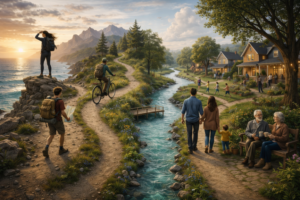
The hybrid lifestyle gives this plurality a structure. Home becomes not a fixed point but a fluid network of meaningful places, each serving a different dimension of a complete life, each known deeply enough to offer genuine belonging rather than mere familiarity. The residence that anchors you. The destinations that expand you. And the freedom to move between them in proportions that evolve as your life evolves.
In an era defined by uncertainty and rapid change, this kind of resilient, intentional relationship with place is not simply a luxury. It is, for those who have built it, one of the most grounding things they own.