In this article, we explore one of the most personal and most rewarding dimensions of returning to the same destination year after year: the gradual accumulation of language. Not formal fluency, but the quiet confidence of knowing enough words in a place’s language to move through it differently. To be greeted differently. To belong, just a little more completely, every time you return.
Nobody expects you to be fluent. That is not the point.
The point is something much simpler and much more immediate than fluency. It is the look on someone’s face when you order your coffee in their language rather than yours. The way a conversation opens when you begin it with a greeting that shows you have made even a small effort. The quality of welcome that changes, almost imperceptibly but unmistakably, when the person on the other side of the counter or the table understands that you are not simply passing through.
Language is one of the most direct expressions of respect for a place and its people. And in the context of the hybrid lifestyle, where returning to the same destination across years gives you time to learn and practice and improve, even a modest investment in a place’s language produces returns that are entirely disproportionate to the effort involved.
What a Few Words Actually Do
Let us be honest about what we are talking about. For most returning travelers, the language of a destination remains limited. A greeting. A thank you. The ability to order food and drink without defaulting to English. Perhaps the name of what you are looking at in a market, or the phrase that means something like excuse me or I am sorry, I do not speak your language well.
This is not fluency. It is not even competence in any serious linguistic sense. But it is something, and something turns out to matter enormously.
The person who greets you in your own language in a foreign country is doing you a kindness. The person who makes the effort to greet you in yours is doing something different. They are acknowledging that you exist in a specific cultural and linguistic context, and that they have chosen to step toward it rather than expecting you to always step toward theirs. This is a small act of respect, and it is felt as such by almost everyone on the receiving end of it.
In a destination you return to year after year, this small act of respect accumulates into something larger. The market vendor who recognizes not just your face but your attempt to speak their language greets you differently from the vendor who sees only another tourist. The restaurant owner who knows you well enough to correct your pronunciation gently, and laugh with you about it, is someone you have a genuine relationship with rather than a transactional one. Language, even in its most basic form, is the currency of genuine connection.
How It Grows Across Returns
One of the particular pleasures of the hybrid lifestyle is that language learning does not have to be deliberate or effortful in the way that formal study requires. It can happen naturally, through repetition and use, across the visits that the lifestyle naturally produces.
On the first visit, you learn the basics. Hello, goodbye, please, thank you, the number system, and the phrases you need to navigate food and transport without panic. These feel like a great deal of effort for a modest result, and on a single visit they are. You do not have enough time to practice them into genuine ease.
On the second visit, something shifts. The phrases you used before come back more quickly. You find yourself reaching for words and occasionally finding them. You add a few new ones, prompted by situations you encounter that the first visit did not produce. By the end of the second visit, you have a small but genuine working vocabulary in the language of this place.
By the fifth or sixth visit, if you have been paying attention and making the effort, you have something that is more than a vocabulary and less than fluency. You have a relationship with the language. You know how it sounds when it is spoken quickly. You recognize words in conversations around you. You can make yourself understood in most everyday situations, and you can understand enough of what is said to you that the exchange feels like a genuine conversation rather than a series of guesses.
This is not fluency. But it is belonging, in one of its most direct linguistic forms.
The Market, the Café, and the Local Shop
The places where limited language makes the most difference are not the restaurants where English is spoken and the menu is translated. They are the everyday places where the local language is simply what is used, because that is where most of the people who live there spend most of their time.
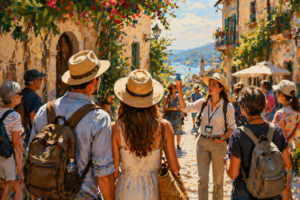
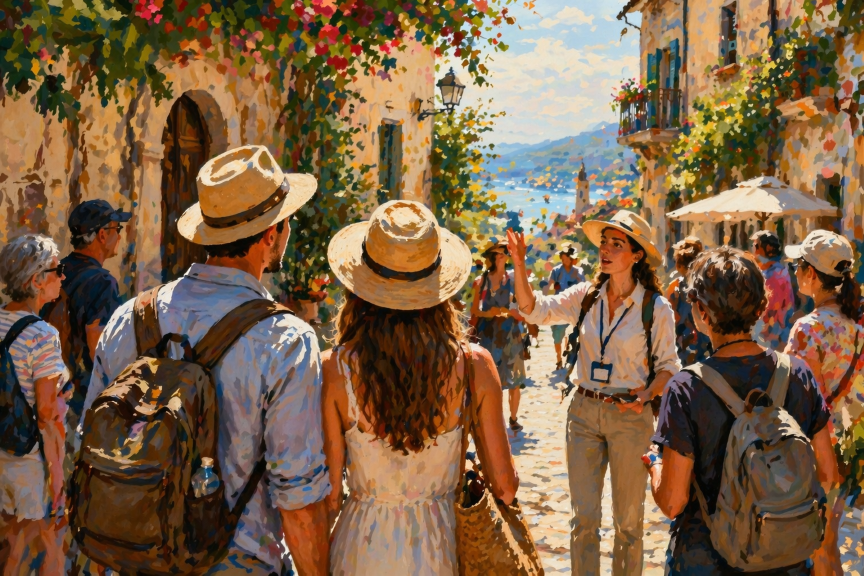
The weekly market. The neighborhood café where the same people gather every morning. The local shop that sells things the tourists do not buy. These are the places where knowing even a little of the language transforms your experience from the outside looking in to something closer to participation.
In these places, the effort you have made is visible in a way that it is not in the tourist-facing parts of the destination. The vendor at the market who hears you ask a question in their language, imperfectly but genuinely, responds differently from the one who is simply pointed at. The café owner who has seen you every visit for three years and has watched your language improve across those years is someone you have a shared history with, and the language is part of that history.
These small moments of genuine communication in an unfamiliar language are among the most quietly satisfying experiences the hybrid lifestyle produces. They are not dramatic. They will not feature in photographs or travel writing. But they are real, and they make a destination feel more genuinely yours with every visit.
What Children Learn Without Trying
One of the most charming dimensions of language in the hybrid lifestyle is what happens with children who grow up returning to the same destination.
Children acquire language differently from adults. They are less self-conscious, less worried about mistakes, and more willing to simply use whatever words they have in whatever combination seems likely to work. A child who returns to the same destination across several years, who plays with local children and watches local television and eats at local restaurants and hears the language spoken around them constantly, absorbs it in a way that their parents, with all their adult caution and embarrassment, often cannot.
Many families who have maintained a co-owned property in a destination across their children’s growing years discover, gradually and with considerable pleasure, that their children have accumulated a genuine working knowledge of the language without ever sitting down to study it. They have simply lived in the place enough times for the language to have entered them naturally, the way any language does for children who are surrounded by it.
This is one of the most lasting gifts the hybrid lifestyle can give to the next generation. Not a formal skill but a living connection, linguistic and cultural, to a place that has become genuinely part of their world.
The Effort That Comes Back Multiplied
The investment required to learn even a modest amount of a destination’s language is genuinely small. An hour or two with an app or a phrasebook before each visit. A willingness to use the words you have rather than retreating to English when things get uncertain. The patience to be corrected and the good humor to laugh at your own mistakes.
The return on this investment is disproportionately large. Not because language learning is magical, but because the effort itself communicates something that matters. It says that this place is worth understanding on its own terms. That the people who live here are worth the small discomfort of trying to reach them in their own language. That you are not a visitor who expects the world to accommodate itself to you, but someone who is willing to do a little of the accommodating yourself.
In a world where it is entirely possible to travel almost everywhere and never use a word of any language other than English, this willingness stands out. It is noticed and appreciated in a way that is almost always warm and often genuinely moving.
And across the years of the hybrid lifestyle, as the language of a beloved destination gradually becomes familiar, it becomes something else as well. It becomes part of how that place sounds in your memory. Part of the texture of what it is to arrive there. Part of the feeling, quiet and real, of being somewhere you belong.