
The appeal of a dedicated vacation residence is one of the most enduring aspirations in the luxury property market. A place that is entirely your own, in a destination you have chosen deliberately, available whenever you want it and maintained to your exact standards. The vision is compelling, and for many buyers it remains a genuine and achievable goal. But the gap between the vision and the lived reality of sole ownership is wider than the purchase price suggests, and understanding that gap honestly is the first step toward making a decision that holds up across years rather than just across the initial excitement of acquisition.
The full cost of traditional second-home ownership is not a secret, but it is frequently underestimated. Not because buyers are uninformed, but because the costs that matter most are distributed across time in ways that make them easy to underweight in a single upfront calculation. By the time the full picture has assembled itself, some owners have discovered that the property they purchased for enjoyment has become, at least in part, a source of obligation.
The Ongoing Costs That Accumulate Quietly
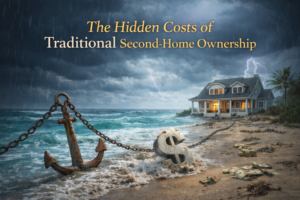
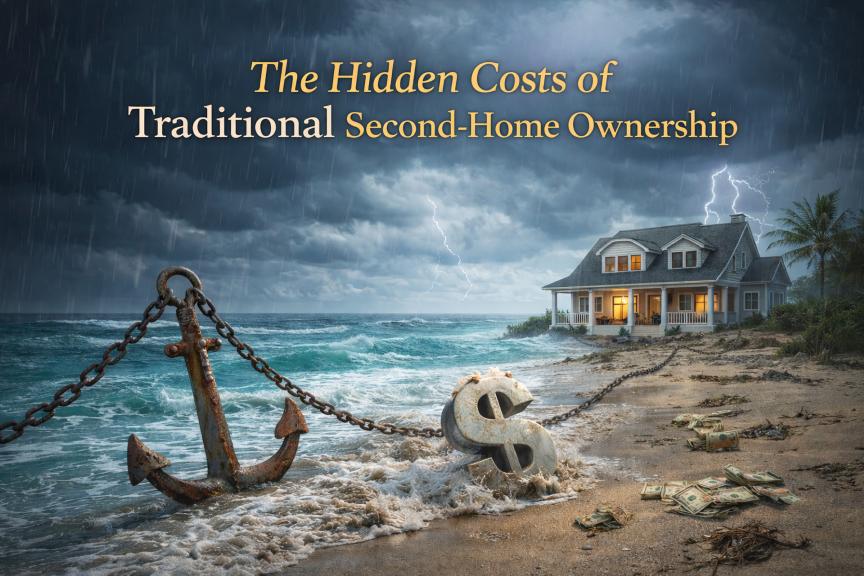
The purchase price of a luxury vacation property is the most visible number in the transaction, but it is not the one that most shapes the long-term financial experience of ownership. That distinction belongs to the annual carrying costs that begin accumulating from the moment the transaction closes and continue regardless of how often the property is used.
Property taxes in desirable vacation destinations are frequently calibrated to peak-season valuations, reflecting the premium that the market assigns to locations with strong seasonal demand. Insurance premiums for coastal, remote, or climate-exposed properties carry their own category of inflation, shaped by the specific risk profile of locations that are often chosen precisely for their dramatic natural settings. And maintenance, the broadest and most variable category of all, encompasses everything from routine landscaping and housekeeping to the unpredictable consequences of weather events, aging infrastructure, and the general entropy that affects any property left unoccupied for significant periods of the year.
Market analyses consistently indicate that ancillary ownership costs in the luxury vacation segment can add three to five percent of property value annually when all categories are properly accounted for. For a property valued at two million dollars, this represents forty to one hundred thousand dollars each year in costs that generate no additional equity and deliver no additional experience beyond maintaining the baseline of what the property already is. For buyers who have approached the investment primarily through the lens of appreciation potential, this figure tends to arrive as a significant recalibration.
The Management Question
Absentee ownership introduces a layer of complexity that buyers whose primary residence is distant from their vacation property often underestimate until they are managing it directly.
Professional property management is not optional for most absentee owners of luxury properties. The coordination of cleaning, landscaping, security, seasonal preparation, and the response to the inevitable unexpected repairs requires either a significant personal time investment or the engagement of third-party services whose costs compound annually. A well-managed luxury property in a sought-after destination typically requires a management infrastructure that delivers genuine peace of mind, and that infrastructure carries a cost that belongs in any honest financial analysis of sole ownership.
The management burden extends beyond logistics. Absentee owners must make decisions about maintenance investments, improvement projects, vendor relationships, and the ongoing standard of the property without the daily familiarity that would make those decisions straightforward. The accumulation of small decisions, each individually manageable, can over time represent a meaningful drain on the time and attention of owners whose lives are already complex.
Liquidity and the Exit Question
The illiquidity of luxury vacation property is a dimension of sole ownership that receives less attention than the carrying costs but that can prove equally significant when circumstances change.
Selling a second home in a niche luxury market is rarely a quick or predictable process. The buyer pool for high-value vacation properties in specific locations is inherently limited, and the combination of transaction fees, staging costs, broker commissions, and potential capital gains tax obligations means that the net proceeds from a sale are typically meaningfully lower than the gross price suggests. In softer market conditions, or in destinations where a single economic factor can shift demand significantly, the timeline for a successful exit can extend considerably beyond what buyers anticipate at the point of purchase.
This illiquidity is not unique to vacation property, but it is worth weighing carefully in the context of an asset whose value to the owner depends significantly on a specific life stage, a particular travel rhythm, or a set of personal circumstances that may evolve over the holding period. The five-to-seven-year timeline within which a meaningful proportion of sole owners find themselves selling, often earlier than they intended, reflects a pattern that deserves honest acknowledgment.
The Psychological Dimension of Underused Ownership
There is a cost of traditional second-home ownership that does not appear in any financial analysis but that experienced owners frequently cite as among the most significant: the psychological weight of an underused asset.
A property that sits empty for the majority of the year carries a particular kind of quiet obligation. The awareness of maintenance that may be needed, of standards that may be slipping in your absence, of money flowing out toward a place you are not currently enjoying, creates a background pressure that can gradually transform a source of anticipated pleasure into a source of ambient stress. The guilt of a neglected property, and the frustration of a schedule that does not allow the visits that would justify the investment, are familiar experiences for a significant proportion of sole vacation home owners.
This emotional dimension is not trivial. The decision to own a vacation property is, at its heart, a decision about quality of life. When the operational reality of that ownership begins to detract from quality of life rather than enhancing it, something important has gone wrong, and the source is usually not the destination but the structure of the ownership itself.
What Co-Ownership Resolves
The co-ownership model addresses the hidden costs of traditional second-home ownership not by eliminating them but by distributing them in ways that align the financial and operational burden with actual use.
Carrying costs are shared proportionally among a small group of co-owners, reducing the annual commitment to a figure that reflects the genuine value extracted from the property. Professional management teams, funded collectively, handle every operational dimension without placing any logistical burden on individual owners. Scheduled usage periods provide the predictability that makes planning meaningful and arrival consistently excellent. And the deeded equity structure preserves the genuine ownership stake and appreciation potential that distinguish the model from purely experiential alternatives.
The psychological dimension resolves most naturally of all. A property that is consistently enjoyed by its owners, professionally maintained between visits, and managed by teams whose entire function is to ensure that arrival is always exceptional, does not generate the background obligation of an underused sole-ownership asset. It generates anticipation.
Choosing the Structure That Serves the Life
Traditional second-home ownership remains the right answer for buyers who genuinely value complete control, who have the time and appetite for the management it requires, and for whom the legacy dimension of an entirely personal property carries meaningful weight. For these buyers, the hidden costs are real but acceptable, and the experience of sole ownership delivers something that no shared model can fully replicate.
For the growing number of affluent buyers who prioritize effortless access, financial prudence, and the consistent enjoyment of an exceptional place without the weight of full individual responsibility, co-ownership offers a genuinely superior alignment of cost, experience, and quality of life.
The true cost of luxury, in the end, is not simply what you pay to acquire it. It is what you invest, financially and personally, to sustain it. The most considered buyers are those who examine both honestly, and choose the structure that serves their actual life rather than the one that best fits the original vision.