
For a long time, the choice seemed unavoidable. You could keep exploring, chasing new destinations each season, collecting experiences across continents, and accepting that no single place would ever feel entirely like yours. Or you could commit, put down roots in one beloved location, and trade the thrill of discovery for the deeper satisfaction of belonging. Two paths, diverging. Pick one and walk it.
What is becoming clear in 2026 is that this was never a real choice. It was a limitation dressed up as a decision. And the most thoughtful luxury travelers are no longer accepting it.
The hybrid lifestyle, blending curated exploration with the quiet anchor of a place you genuinely own, is not a compromise between two options. It is a third path altogether, and for a growing number of affluent buyers, it is the one that most honestly reflects how a well-designed life actually feels.
The Shape of a Hybrid Year
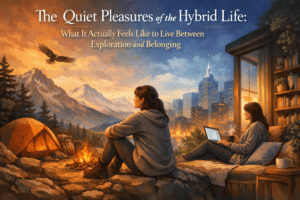
Picture the rhythm of it. Part of the year is given over to discovery: a month moving through Tuscany’s lesser-known villages, a few weeks on a quiet Caribbean island, a winter season in the mountains. These journeys remain open and unhurried, shaped by curiosity rather than obligation. They keep the world feeling large and endlessly generative.
Then comes the return. Not to a hotel room or a rented villa, but to a place that already knows you. A co-owned residence where the sunrise view is familiar, where the walking paths feel like yours, where arrival requires no orientation and no effort. The decision fatigue of constant movement dissolves. What replaces it is something more valuable: the particular ease of a place that welcomes you back like an old friend.
This rhythm, exploration and return, discovery and belonging, is not a luxury indulgence. It is, increasingly, a considered life strategy.
Built to Evolve With You
One of the hybrid lifestyle’s most underappreciated qualities is its adaptability. The balance between travel and belonging does not need to remain fixed. It can shift as life shifts, accommodating new demands and changing priorities without requiring a complete restructuring of how you live.
When children are young and novelty is welcome, the travel half of the equation can be generous and varied. As schedules grow more demanding, as aging parents require proximity, as the appeal of familiarity deepens with experience, the owned residence becomes more central. The emotional recharge that exploration provides does not disappear. It simply finds a new proportion within a life that has evolved.
This flexibility is something neither permanent relocation nor perpetual travel can offer on its own. It is unique to the hybrid approach, and it is one of the reasons the model resonates so strongly with buyers whose lives are genuinely in motion.
The Financial Logic Is Equally Compelling
The lifestyle case for the hybrid model is intuitive. The financial case is equally strong, and worth examining with the same care.
Full ownership of a luxury second home carries costs that extend well beyond the purchase price. Maintenance, property taxes, insurance, staffing, and the carrying cost of weeks that go unused accumulate into a significant annual burden. For a property that may be occupied for only a fraction of the year, the economics of sole ownership can be difficult to justify honestly.
Curated travel programs offer access to exceptional properties and destinations that would never warrant individual ownership, at rates that reflect their occasional rather than permanent use. Fractional ownership reduces the financial weight of a dedicated residence to what is actually used, distributing maintenance, taxes, and operational costs proportionally among co-owners. Together, the two components of the hybrid model deliver a standard of living that frequently surpasses what either approach could achieve independently, at a fraction of the combined cost.
The result is not a reduction in quality. It is a reallocation of resources toward the experiences and connections that matter most.
Redefining What Luxury Means in Practice
The hybrid lifestyle represents something larger than a clever financial strategy or a practical travel framework. It reflects a fundamental shift in what affluent buyers understand luxury to mean.
Luxury is no longer defined by the weight of what you possess. It is defined by the quality of how you live, the depth of your connection to the places you return to, and the freedom to remain curious about the ones you have not yet found. It is flexible where it once was rigid, personal where it once was prescriptive, and quietly satisfying in a way that conspicuous accumulation rarely manages to be.
The debate between more trips and finally owning somewhere special is resolved not by choosing one over the other, but by recognizing that they serve different and complementary needs. Exploration nourishes the part of us that wants the world to remain surprising. Belonging nourishes the part that wants somewhere to come home to. Both are essential. Neither is optional.
A Balance Worth Designing For
The hybrid luxury lifestyle does not arrive fully formed. It is designed, thoughtfully and gradually, around the specific contours of a life. The destinations, the frequency of travel, the nature of the co-owned residence, the proportion of exploration to return: all of these can be shaped to fit the reality of who you are and how your priorities are likely to evolve.
What the model offers, at its core, is permission. Permission to stop treating exploration and belonging as competing values, and to build a life that honors both fully.
For those who have long felt the pull in two directions at once, the hybrid lifestyle is not a compromise. It is, finally, an answer.