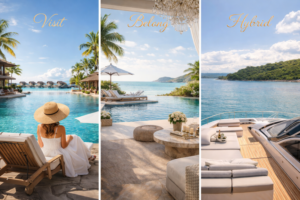


There is a particular vision that draws people toward luxury vacation property: waking to an oceanfront morning in Maui, or stepping onto a private terrace in the Alps as the light shifts across the mountains. The destination is vivid. The experience is clear. What has historically stood between that vision and its realization is not a lack of desire but the scale of commitment that sole ownership of a multimillion-dollar property requires, and the honest recognition that the financial and operational weight of that commitment can, over time, diminish the very pleasure it was meant to provide.
Co-ownership has emerged as the answer to this particular tension, and the most sophisticated buyers in the luxury property market have begun to understand it not as a compromise on that vision but as a more intelligent path to realizing it fully. Not owning less. Owning smarter.
What Co-Ownership Actually Means
The term co-ownership is used broadly enough that it is worth establishing clearly what it means in the context of luxury vacation properties, and equally importantly, what it does not mean.
A deeded fractional share in a co-owned luxury residence is a genuine real estate asset. It is legally recorded, carries equity that can appreciate in line with the underlying property value, and can be sold independently at market value when the time comes to exit. This is not a timeshare arrangement, in which buyers purchase the right to use a property during a designated period without any ownership stake in the underlying asset. The distinction is fundamental, and it is the foundation of why the co-ownership model has attracted serious buyers who might previously have dismissed shared property arrangements entirely.
Ownership is typically structured in shares of between one-eighth and one-quarter of a property, held by a small group of like-minded co-owners whose usage patterns and lifestyle preferences have been considered for compatibility at the point of entry. Usage is allocated through carefully designed scheduling systems that distribute access fairly across the ownership group, with professional management teams handling every operational dimension of the property between visits.
What the co-owner experiences on arrival is indistinguishable, in terms of quality and personal attention, from the experience of a sole owner arriving at their own property. What is different is the financial architecture that makes that experience sustainable and intelligent.
The Case That Makes Itself
The financial logic of luxury co-ownership becomes clearer the more honestly it is examined against the full cost of the alternatives.
Sole ownership of a high-caliber vacation property in a sought-after destination carries the complete weight of acquisition, maintenance, property taxes, insurance, staffing, and the opportunity cost of capital committed to an asset that may be occupied for only a fraction of the year. For a property used for six to eight weeks annually, the carrying cost per night of sole ownership rarely reflects the value that is actually being extracted from the investment.
Co-ownership distributes these costs proportionally among a small group of owners, reducing the annual financial commitment to a figure aligned with actual use. Entry costs at a fraction of the full acquisition price preserve capital for other investments or experiences. And the deeded equity stake means that appreciation in the underlying property value accrues to the owner’s benefit, as it would in any real estate investment.
Many platforms extend the financial picture further through rental programs that make the property available during unoccupied periods, generating income that can offset carrying costs meaningfully and in some cases substantially. The result is access to a genuinely exceptional property, professionally maintained to the highest standard, at a net cost that frequently compares favorably to equivalent rental expenditure, and with the addition of an appreciating asset that rental payments never produce.
The Experience of Genuine Ownership
The financial case for co-ownership is compelling. The experiential case is what makes it transformative.
The co-owned residence offers something that even the finest rental property cannot: the particular quality of a place that already knows you. Preferred wines are waiting. The staff are familiar. The room you love most is ready. The accumulated personal touches that transform a beautiful property into a genuine home away from home are present from the first moment of arrival rather than built gradually across a stay and then reset for the next guest.
This sense of genuine ownership deepens with every visit. The destination becomes more familiar, the local relationships more established, and the ease of arrival more complete. Children develop a relationship with a landscape across seasons and years. Family traditions form naturally around a place that recurs reliably in the calendar rather than being negotiated afresh each time.
For families in particular, this quality of consistency is one of the most quietly significant things co-ownership provides. The shared joy of a place that belongs to the family in a meaningful sense, that accumulates memories across years rather than offering a single exceptional experience and then disappearing, is a form of value that no financial analysis fully captures but that most families who experience it recognize immediately.
Conscious Ownership for a More Considered Life
There is a dimension to the co-ownership model that speaks to something broader than financial efficiency or experiential quality, and it is worth naming directly.
Sharing ownership of a high-caliber property with a small group of like-minded buyers is, at its heart, an act of conscious resource allocation. It reflects a decision to use what is genuinely needed, to share what would otherwise sit idle, and to structure one’s relationship with property around actual value rather than symbolic possession. In this sense, co-ownership is not simply a more affordable path to luxury. It is a more considered one.
The shift from owning an entire multimillion-dollar property that is occupied for a fraction of the year to holding a deeded share in a beautifully managed property that is genuinely used by everyone who owns it is a shift that reflects the same values driving the broader evolution of luxury: away from excess, toward intention. Away from accumulation, toward curation. Away from what impresses, toward what genuinely enriches.
For families who want to share the joy of exceptional places with the people they love most, without overextending the resources that make that generosity possible, co-ownership represents exactly the balance the model was designed to provide.
Choosing the Right Platform and Property
The quality of the co-ownership experience depends significantly on the platform through which it is accessed, and the due diligence applied at the point of entry shapes everything that follows.
The most credible platforms maintain rigorous standards for property selection, co-owner compatibility, governance transparency, and management quality. They offer clear ownership agreements, well-designed scheduling systems, responsive support teams, and structured resale processes that protect long-term value. The track record of the operator, the quality of the properties in their portfolio, and the robustness of their governance framework are all worth evaluating carefully before committing to a specific opportunity.
Location remains the primary driver of long-term value, as it is in every form of real estate. Properties in destinations with year-round appeal, constrained supply, and consistent international demand are positioned most strongly for appreciation and resale liquidity. The combination of a prestigious address, exceptional construction quality, and professional management creates the conditions under which co-ownership delivers most fully on its promise.
A More Intelligent Relationship With the Places You Love
The vision that draws people toward luxury vacation property, the private terrace, the oceanfront morning, the mountains at first light, is not diminished by the intelligence of co-ownership. It is made more sustainable, more financially sound, and more genuinely personal.
This is not about owning less. It is about owning with greater intention, in places that have earned your loyalty, through structures that align the scale of the investment with the reality of how the property enriches your life.
For those who have always believed that the finest things are worth having wisely, co-ownership offers something rare: a path to the places you love most that is as considered as it is extraordinary.